The Body’s Own Off Switches: Checkpoint Inhibitors Part 2 of 6

News Release
October 6, 2026

The Body’s Own Off Switches: Checkpoint Inhibitors Part 2 of 6

“Cancer’s cleverest trick is not hiding from the immune system. It is using the immune system’s own off switch against it.”
Dr Carman Giacomantonio, CMO, Sona Nanotech

In my last article I explained how your immune system is designed to find and destroy cells that have gone wrong. But here is a question I get asked more than almost any other: if the immune system is that good, why does cancer survive at all?

The short answer is that some cancers have learned to use the immune system’s own brakes against it.

That word, brakes, is the right one. Your immune system does not run at full power all the time, and it is not supposed to. If it did, it would attack your own healthy tissue. So the body builds in automatic braking signals, called immune checkpoints, that tell immune cells when to slow down and stop. Cancer has figured out how to trigger those brakes on command. Checkpoint inhibitors are the drugs designed to release them.

Why Your Immune System Has Brakes

Think about what your immune system is doing every day. It is scanning billions of cells, distinguishing between “self” and “not self,” and occasionally encountering cells that have mutated or been infected. When it finds something wrong, it mounts an attack. That attack is inflammatory, aggressive, and, if left completely unchecked, dangerous.

So the body evolved braking signals. These are molecular conversations between cells: one cell displays a signal that says, in effect, “I am one of yours, stand down,” and an immune cell reads that signal and backs off. This is not a flaw in the immune system. It is the mechanism that prevents autoimmune disease, where the immune system attacks healthy tissue.

The problem is that cancer cells can hijack that same mechanism. They display the “stand down” signal, and the immune cell, doing exactly what it was designed to, steps back.

The PD-1/PD-L1 Handshake

The most studied of these braking mechanisms involves two proteins: PD-1 and PD-L1.

PD-1 (programmed cell death protein 1) sits on the surface of T cells, the immune system’s front-line fighters. It is essentially a sensor waiting for a particular signal. PD-L1 is that signal. When a cell displays PD-L1 on its surface, it is sending a message: “I belong here. Do not attack me.” The National Cancer Institute describes immune checkpoints as regulators that help prevent immune cells from attacking normal cells, the same mechanism cancer exploits.

In healthy tissue, this is a sensible conversation. Normal cells expressing PD-L1 are telling T cells to stand down, preventing friendly fire against healthy tissue. But many cancer cells have learned to overexpress PD-L1, flooding the surface with “I belong here” signals, even while they are actively multiplying and spreading.

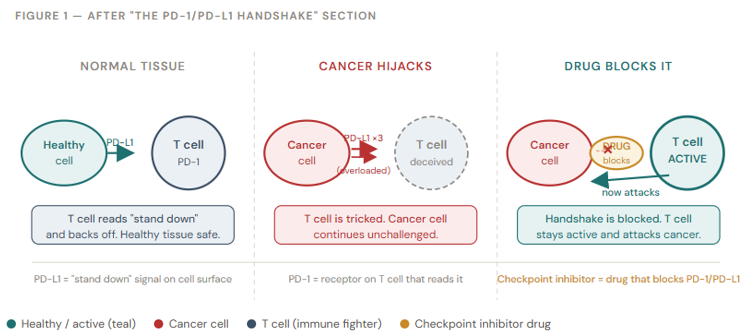
When a PD-1 receptor on a T cell connects with a PD-L1 signal on a cancer cell, the T cell essentially stands down. It reads the signal the way it was designed to, is deceived, and backs away. The cancer continues unchallenged.

PD-1/PD-L1 checkpoint inhibitors (drugs like pembrolizumab/Keytruda and nivolumab/Opdivo) work by blocking that handshake. They bind to either the PD-1 receptor or the PD-L1 signal, physically preventing the conversation from happening. Without the “stand down” cue, the T cell stays active. The American Cancer Society notes that these drugs have changed outcomes for some patients with cancers that had previously been difficult to treat.

Figure 1: The PD-1/PD-L1 handshake. In normal tissue (left), healthy cells display PD-L1 and T cells read it as “stand down” — a protection against autoimmune attack. Cancer cells (centre) exploit this by overloading the same signal, tricking T cells into backing away. A checkpoint inhibitor drug (right) physically blocks that signal, so the T cell stays active and resumes its attack on the cancer.

CTLA-4: The Earlier Brake

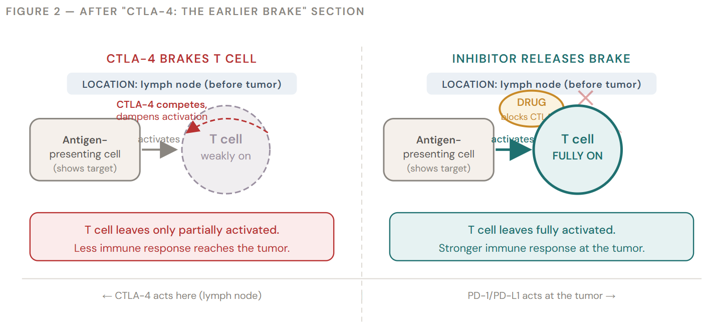
There is a second major braking mechanism worth understanding, because it operates earlier in the immune response. CTLA-4 (cytotoxic T-lymphocyte-associated protein 4) acts as a brake during the activation phase of T cells, before they have even reached the tumor.

When a T cell is being primed to recognize and fight a specific target, CTLA-4 competes for the activation signal. Think of it as a second checkpoint that moderates how aggressively a T cell gets activated in the first place. Cancer can exploit this pathway too, dampening T cell activation before the fight begins.

Ipilimumab (Yervoy) is the best-known CTLA-4 inhibitor. It works by blocking that early brake, allowing T cells to activate more fully and mount a stronger initial response. In clinical practice, CTLA-4 and PD-1 inhibitors are sometimes combined to release both the early and late brakes simultaneously, an approach that has shown higher response rates in some cancers alongside higher rates of side effects.

Figure 2: CTLA-4 — the earlier brake. CTLA-4 operates before T cells even reach the tumor, in the lymph node where they are being primed and activated. Normally, CTLA-4 competes with the activation signal and moderates how strongly a T cell is switched on. Cancer can exploit this too, keeping T cells weakly activated before they set off. A CTLA-4 inhibitor drug blocks that dampening signal and lets T cells leave the lymph node in a stronger, more active state. This is an earlier brake than PD-1/PD-L1, which acts at the tumor itself.

What Checkpoint Inhibitors Actually Do

Checkpoint inhibitors do not attack cancer directly. That distinction matters and is worth sitting with for a moment.

They remove the molecular brake that cancer has been pulling. Once that brake is released, the immune system, which was always capable of attacking the cancer, can do so. The drug’s job is to get out of the way, not to do the fighting itself.

In study conditions, this approach has shown durable responses in some patients. Some cancers that were progressing despite prior treatment have shown significant regression after checkpoint inhibition. In melanoma, where checkpoint inhibitors first demonstrated landmark results, five-year survival rates in study populations improved substantially compared to historical outcomes with chemotherapy. A 2025 review published in Frontiers in Immunology examined the mechanisms underlying both checkpoint inhibitor response and resistance, providing context for understanding why outcomes vary so significantly across patients.

But here is the critical word in those results: some.

Figure 3: Who responds to checkpoint inhibitors? Across approved solid tumor indications in study populations, analyses suggest that 50 to 70 percent of patients may not achieve a meaningful response to checkpoint inhibitor therapy. Rates vary considerably by cancer type, mutation burden, and tumor characteristics. This is not a failure of the concept — it is a signal that releasing the brake only works when an immune response is already present to release.

When the Engine Is Not Running

The brake analogy explains a lot. But it misses something important that I think about constantly in my work.

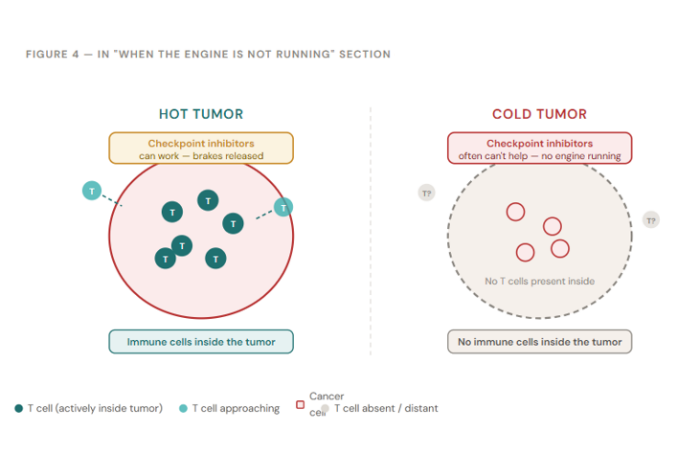
Releasing a brake only works if there is an engine running. In other words: checkpoint inhibitors can release the immune system’s brakes, but if the immune system has not been activated against the tumor in the first place. If the T cells have not been primed to recognize those specific cancer cells, releasing the brake does not solve the problem.

Some tumors are what researchers call “cold” tumors. They do not attract much immune attention. They are not heavily infiltrated with T cells. There is no meaningful immune response to release. For these patients, checkpoint inhibitors often do not work, not because the brakes remain on, but because the engine was not running to begin with. This concept of tumor “immunogenicity” is explored further in the next article in this series, where we look at what makes a tumor’s environment hostile or receptive to immune attack.

Across cancer types, the majority of patients treated with checkpoint inhibitors in study populations do not respond. Estimates across approved indications vary, but many analyses suggest that 50 to 70 percent of patients may not achieve a meaningful response. That is not a failure of the concept. It is a signal that something else is missing.

This is the frontier question in immuno-oncology right now. How do you turn a cold tumor hot? How do you generate or amplify an immune response that checkpoint inhibitors can then sustain? That question is what is driving some of the most important combination therapy research in the field, including the direction we explore in Article 4: Why Immunotherapy Fails and What Researchers Are Doing About It.

Hot Tumor vs. Cold Tumor: Why the Engine May Not Be Running

Figure 4: Hot tumor vs cold tumor. A “hot” tumor (left) has been infiltrated by T cells — the immune system has recognized it and started fighting. Checkpoint inhibitors can work here: they release the molecular brakes that cancer is using to slow the immune attack. A “cold” tumor (right) has not attracted meaningful immune activity. The T cells are not there. Releasing the brakes does not help if the engine was not running. This distinction — hot vs cold — is one of the most important questions in combination therapy research.

This is the frontier question in immuno-oncology right now. How do you turn a cold tumor hot? How do you generate or amplify an immune response that checkpoint inhibitors can then sustain? That question is what is driving some of the most important combination therapy research in the field, including the direction we explore in Article 4: Why Immunotherapy Fails and What Researchers Are Doing About It.

Side Effects: When the Brakes Come Off Too Hard

One question I see come up often in conversations about checkpoint inhibitors, and one I hear from patients and families directly: what happens when you release the immune system’s brakes and it starts attacking healthy tissue?

That concern is legitimate, and the science does not sidestep it.

Immune-related adverse events (side effects that arise because the immune system becomes overactive) are a documented feature of checkpoint inhibitor therapy. Because PD-1 and CTLA-4 normally regulate immune responses in healthy tissue as well as in tumors, blocking those signals can occasionally lead the immune system to attack the gut, the lungs, the skin, the thyroid, or other organs.

These events vary in severity. Most are manageable, and many resolve when the drug is paused and immune-suppressing treatment (usually corticosteroids) is administered. But some are serious, and in rare cases can be life-threatening. This is why checkpoint inhibitor therapy is delivered and monitored in specialized oncology settings.

The clinical goal is to release the brakes in a targeted enough way that cancer is affected but healthy tissue is not. Getting that balance right is one of the defining challenges of modern immunotherapy.

Why This Matters for What Comes Next

Checkpoint inhibitors are not the end of the immunotherapy story. They are, I would argue, the beginning of the harder question.

We know the brakes can be released. We know that works for some patients. We know the side effect profile requires careful management. And we know that for the majority of patients in most solid tumor types, something else is needed to prime the immune response before the brakes are released.

In my next article, I will explain what happens inside a tumor’s microenvironment, the ecosystem that determines whether an immune response can get established in the first place. It is the environment around the cancer, not just the cancer itself, that increasingly determines how immunotherapy works. Understanding it changes how you think about treatment strategy.

How This Connects to Our Work at Sona

Our Targeted Hyperthermia Therapy (THT) is not a checkpoint inhibitor. It is a different class of approach entirely, using CTAB-free gold nanorods to deliver precise, controlled heat directly into solid tumor tissue.

But the question of cold tumors connects directly to what we are studying. Our first-in-human trial, recently completed in immunotherapy-resistant cutaneous metastatic melanoma, enrolled patients who had already failed checkpoint inhibitor therapy. These were patients for whom releasing the brakes had not been enough. You can read more about the THT mechanism in Article 5 of this series.

One hypothesis in the scientific community, supported by independent research including a 2026 study published in Nature examining the combination of local tumor ablation with PD-1 inhibition, is that local treatment of a tumor can generate the immune signal that cold tumors are missing. Heat-mediated tumor cell death may release tumor-associated antigens that are taken up by antigen-presenting cells, potentially helping T cells recognize and target the tumor, and creating the immune activity that checkpoint inhibition can then sustain.

Our first-in-human study results, showing an 80% overall response rate and a 60% complete response rate in patients who had stopped responding to prior immunotherapy, are being prepared for peer-reviewed publication. Our next planned Canadian clinical trial will examine THT in combination with immunotherapy, pending Health Canada Investigational Testing Authorization (ITA). You can follow our clinical pipeline here.

That is the scientific rationale. The clinical story is still being written. But the checkpoint inhibitor chapter is what makes the question intelligible. More on the preclinical data behind THT can be found in our peer-reviewed publication in the Journal of Nanobiotechnology (2026).
Frequently Asked Questions

What is a checkpoint inhibitor in cancer treatment?

A checkpoint inhibitor is a drug that blocks the molecular signals cancer uses to switch off immune cells. The immune system has built-in braking signals, called checkpoints, that prevent it from attacking healthy tissue. Some cancers hijack these signals to avoid immune destruction. Checkpoint inhibitors release those brakes, allowing the immune system to resume its attack on cancer cells.

What is the difference between PD-1 and CTLA-4 inhibitors?

PD-1 inhibitors (such as pembrolizumab and nivolumab) block a signal that cancer cells use to silence T cells at the tumor site. CTLA-4 inhibitors (such as ipilimumab) block an earlier brake that limits how aggressively T cells activate before they even reach the tumor. PD-1 acts at the point of attack; CTLA-4 acts during T cell preparation. Both are used in clinical practice, sometimes in combination.

Why do checkpoint inhibitors not work for all patients?

Checkpoint inhibitors release the immune system’s brakes, but they only work if an immune response against the tumor is already present. Many tumors are “cold”: they are not infiltrated by T cells and have not triggered a meaningful immune reaction. For these patients, releasing the brake does not help because the engine was not running. This is the central challenge driving combination therapy research.

What are the side effects of checkpoint inhibitor therapy?

Because checkpoint inhibitors reduce the immune system’s normal braking signals, they can cause the immune system to attack healthy tissue. These immune-related adverse events can affect the gut, lungs, skin, thyroid, and other organs. Most are manageable with corticosteroid treatment, but some can be serious. Checkpoint inhibitor therapy is administered in specialized oncology settings precisely because of this monitoring requirement.

Can checkpoint inhibitors be combined with other cancer treatments?

Yes. Combining checkpoint inhibitors with other treatments, including other immunotherapy agents, local tumor ablation, or targeted therapies, is one of the most active areas of cancer research. The rationale is that some treatments may help generate or amplify an immune response against the tumor, providing T cells with a clearer target, and checkpoint inhibitors then sustain that response. Independent peer-reviewed research, including a 2026 Nature study, has examined local ablation combined with PD-1 inhibition in solid tumors.

Sources

  1. National Cancer Institute. Immune Checkpoint Inhibitors. cancer.gov/about-cancer/treatment/types/immunotherapy/checkpoint-inhibitors
  2. American Cancer Society. Checkpoint Inhibitors. cancer.org/cancer/managing-cancer/treatment-types/immunotherapy/checkpoint-inhibitors.html
  3. Kennedy et al. (2025). Immunotherapy resistance mechanisms. Frontiers in Immunology. doi:10.3389/fimmu.2024.1512543
  4. Kennedy et al. (2026). Sona Nanotech THT preclinical data. Journal of Nanobiotechnology. doi:10.1186/s12951-026-04310-8
  5. Tselikas et al. NIVIPIT Trial (2026). Nature. doi:10.1038/s41586-026-10341-w [Independent peer-reviewed research, not Sona data]
  6. Health Canada. Clinical Trials Guidance. canada.ca/en/health-canada/services/drugs-health-products
  7. BIOTECanada. Canadian Biotech Innovation. biotech.ca

Author