Sona's THT Leverages Its Uniquely Biocompatible Gold Nanorods
Sona Nanotech’s Targeted Hyperthermia Therapy™ (THT) is a next-generation precision cancer treatment that uses CTAB-free, uniquely biocompatible gold nanorods (GNRs) to deliver controlled, localized heat directly into solid tumors. This precise thermal activation induces apoptotic cancer cell death, reveals tumor antigens, and helps activate the immune system.
THT is designed to minimize damage to healthy tissue while overcoming the limitations of traditional cancer treatments and immunotherapy resistance. In 2025, THT demonstrated compelling early human efficacy in immunotherapy-resistant melanoma, achieving an 80% overall response rate and 60% complete responses in a first-in-human feasibility study, with a favourable safety and tolerability profile.
How does THT work?
Sona’s patented, CTAB-free, uniquely biocompatible gold nanorods (GNRs) are delivered directly into solid tumors via intratumoral injection. When activated by near-infrared (NIR) light tuned to their same wavelength, the GNRs gently heat tumors from the inside, triggering apoptotic cell death* and revealing tumor neoantigens that help the immune system better engage to fight the tumor cancer.
- Precise Delivery: Gold nanorods are injected into the tumor.
- Activation by Infrared Light: NIR light is applied via a hand-held laser which passes non-thermal light energy that penetrates up to ~2.5cm of tissue and is absorbed by the GNRs.
- Localized Heating: The gold nanorods convert the absorbed light to therapeutic hyperthermic heat, inducing apoptotic cancer cell death while minimizing damage to surrounding healthy tissue.
- Immune Engagement: Destroying cancer cells also exposes tumor neoantigens, which can stimulate the patient’s immune system to recognize and attack cancer cells, including those previously hidden from immune detection.
*Apoptotic Cell Death: When a cell actively self-destructs in a controlled manner. In so doing, the dying cells become more “visible” to immune cells due to the altered antigen presentation which can cause the immune system to engage and attack the cancer.
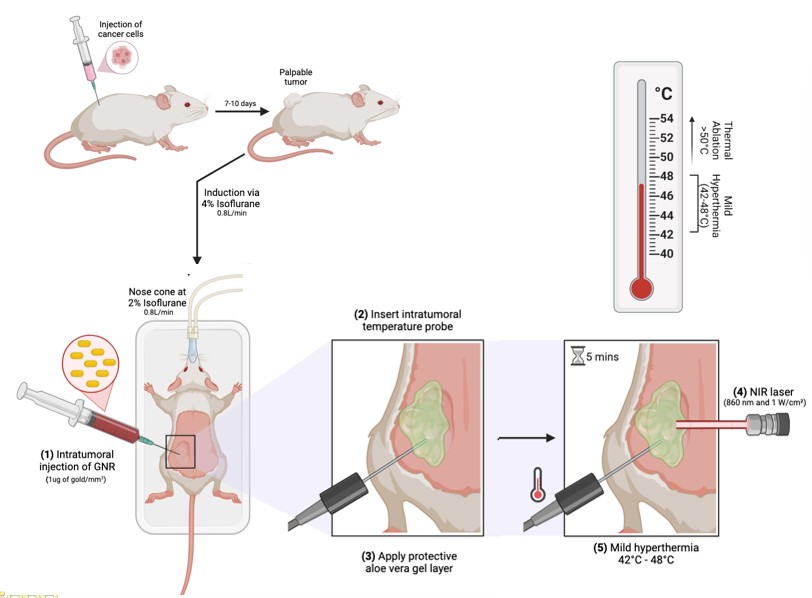
Sona’s THT Involves Two Injections Of GNRs Followed By ~5 Minutes Of Sona’s Near-infrared Laser Energy Which GNRs Convert To Heat
Clinical Progress & Recent Milestones
Early Feasibility Study Results (2025)
Sona Nanotech completed its first-in-human early feasibility study evaluating Targeted Hyperthermia Therapy™ (THT) in patients with immunotherapy-resistant melanoma. The study demonstrated compelling early human efficacy, including:
overall response rate
complete responses in biopsied tumors
Favourable safety and tolerability, with no THT-related serious adverse events
procedural and device refinements supporting ongoing optimization
These results represent the first clinical evidence that CTAB-free gold nanorod-based hyperthermia can shrink tumors and engage immune responses in humans.
Study Design
Participants received two THT treatments one week apart, with the study evaluating:
- Safety and tolerability
- Tumor response
- Local immune engagement
- Device and procedural performance
Preclinical Foundation
Prior to human testing, THT demonstrated strong preclinical efficacy across multiple cancer models including melanoma, and colorectal and triple negative breast cancer. Studies showed that combining THT with immunotherapy can convert immune-resistant “cold” tumors into “hot” tumors, enhancing immune activation and improving treatment outcomes.
Next Steps in Clinical Development
Following the favourable early feasibility clinical outcomes:
- Combination therapy: Sona’s first-in-human study established that THT safely shrinks tumors and activates the immune system. The next step is combination therapy, testing whether THT can make immunotherapy work for the patients it currently fails. IGNITE-THT will test THT combined with the same immunotherapy drugs on which late-stage melanoma patients had previously failed. Early result read-out expected within six months of initiation. PRIME-THT will test THT combined with intratumoral immunotherapy in newly diagnosed early-stage melanoma patients before surgery. Up to 275,000 early-stage melanoma patients are diagnosed globally each year. Early result read-out expected within eight months of initiation. A larger-scale combination therapy clinical trial, guided by active Health Canada feedback, is targeting initiation in early 2027 and will run up to 18 months with multiple read-out milestones.
- A pilot study of ~30–40 patients is planned for 2026, pending regulatory clearance.
- The pilot study will refine treatment parameters, evaluate multi-centre deployment, and generate data to inform pivotal trial design.
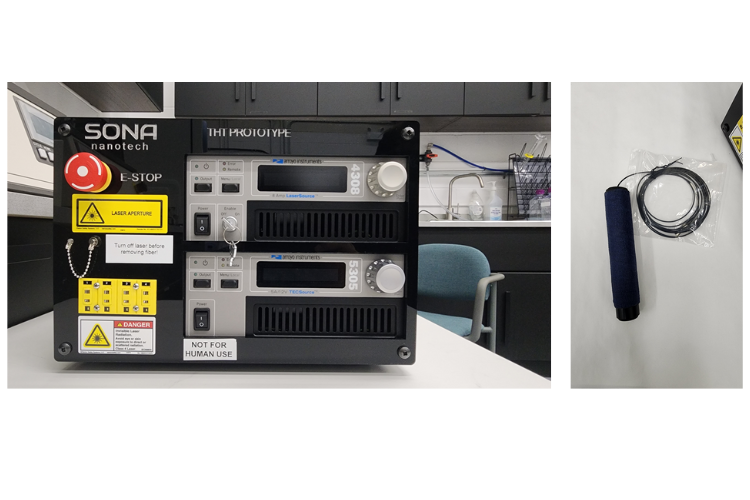
Next Gen Laser
Sona’s Next Generation Laser is a custom-engineered, near-infrared light device designed specifically for use with Sona’s gold nanorod (GNR) technology in Targeted Hyperthermia Therapy (THT). This device has undergone extensive validation and verification to ensure it reliably delivers consistent energy output with robust safety features, meeting the stringent requirements of clinical trials and regulatory bodies.
- Optimized wavelength (860 nm): Penetrates up to one inch into tissue, allowing precise targeting of tumors from the surface or within body cavities
- Consistent, reliable energy delivery: Rigorously validated for clinical use, with built-in safety features to ensure dependable performance
- Non-invasive approach: Enables access to tumors with harmless near infrared light without the need for surgical procedures, supporting minimally invasive cancer therapy.
Unlike surgical lasers that cut or ablate tissue, Sona’s laser gently transmits non-thermal near-infrared light, which is absorbed by the injected gold nanorods. These nanorods then convert the light into heat, selectively destroying cancer cells from the inside out while sparing healthy tissue. This approach not only treats tumors directly but also has the potential to stimulate the immune system, supporting Sona’s vision for innovative, minimally invasive cancer therapies.
Advantages & Future Potential
Minimally Invasive
THT delivers precise, localized thermal activation within tumors, reducing collateral damage and minimizing side effects compared with systemic chemotherapy, radiation, or surgical intervention.
Immune System Activation
By inducing selective apoptotic cancer cell death and revealing tumor neoantigens, THT helps engage the immune system — a mechanism supported by both preclinical studies and early human findings in immunotherapy-resistant melanoma.
Versatile Platform
Sona’s gold nanorod (GNR) platform is being advanced for multiple solid tumor types. Insights from the early feasibility study will inform expansion into additional indications as part of future clinical development.
Safety & Biocompatibility
Sona’s CTAB-free, uniquely biocompatible gold nanorods eliminate the toxicity concerns associated with legacy gold nanorod technologies. Independent validation from the US NIH’s National Cancer Institute’s Nanotechnology Characterization Laboratory (NCL) reassessed Sona’s GNRs as stable and free of detectable endotoxins.
Clinical Integration
As a locally delivered, immune-activating therapy, THT is designed to complement existing cancer treatments. Early clinical results suggest the potential for meaningful integration alongside immunotherapies in patients with treatment-resistant disease.
Read More About Targeted Hyperthermia
First Patient Dosed in Early Feasibility Study Trial of Its Cancer Therapy

Next Steps
What comes next: combination therapy Sona’s first-in-human study established that THT safely shrinks tumors and activates the immune system. The combination therapy programme now tests whether THT can make immunotherapy work for the patients it currently fails. IGNITE-THT (announced May 5, 2026) tests THT combined with the same immunotherapy drugs on which late-stage melanoma patients had previously failed. Early result read-out expected within six months of initiation.
PRIME-THT (announced May 5, 2026) tests THT combined with intratumoral immunotherapy in newly diagnosed early-stage melanoma patients before surgery. An estimated 275,000 early-stage melanoma patients are diagnosed globally each year. Early result read-out expected within eight months of initiation. A larger-scale Health Canada ITA combination trial, supported by active Health Canada feedback, is targeting initiation in early 2027 and will run up to 18 months with multiple read-out milestones.
What is Targeted Hyperthermia Therapy?
Targeted Hyperthermia Therapy (THT) is Sona Nanotech’s proprietary cancer treatment that uses CTAB-free gold nanorods to deliver controlled heat inside solid tumors. The heat triggers apoptotic cell death and immune activation. Sona’s first-in-human study in immunotherapy-resistant melanoma demonstrated an 80% overall response rate in 10 patients. |
What is IGNITE-THT?
IGNITE-THT is a clinical study testing Sona Nanotech’s Targeted Hyperthermia Therapy combined with immunotherapy in late-stage melanoma patients who have previously failed on those same immunotherapy drugs. Early result read-out is expected within six months of study initiation. |
What is PRIME-THT?
PRIME-THT is a clinical study testing THT combined with intratumoral immunotherapy in newly diagnosed early-stage melanoma patients before surgical resection. The study targets a population estimated at 275,000 patients globally per year. Early result read-out expected within eight months of initiation. |
What did Sona Nanotech's first-in-human study show?
Sona’s first-in-human study completed in October 2025 tested THT in 10 late-stage melanoma patients who had all previously failed standard immunotherapy. The study achieved an 80% overall response rate. Six of the eight responding patients showed no detectable residual melanoma in representative biopsied tumors within two weeks. |